
2015 European PV Solar Energy Conference and Exhibition

PTIRLocal measurement of photocurrent and band gap in CdTe solar cells”, Y. Yoon, J. Chae, A. Katzenmeyer, H. Yoon, J. Schumacher, S. An, A. Centrone, N. Zhitenev, 31st European Photovoltaic Solar Energy Conference and Exhibition, p. 1243, 2015. (DOI: 10.4229/EUPVSEC20152015-3DV.1.34)

1. Center for Nanoscale Science and Technology, National Institute of Standards and Technology, Gaithersburg, Maryland, 20899, USA.
2. Maryland Nanocenter, University of Maryland, College Park, Maryland, 20742, USA


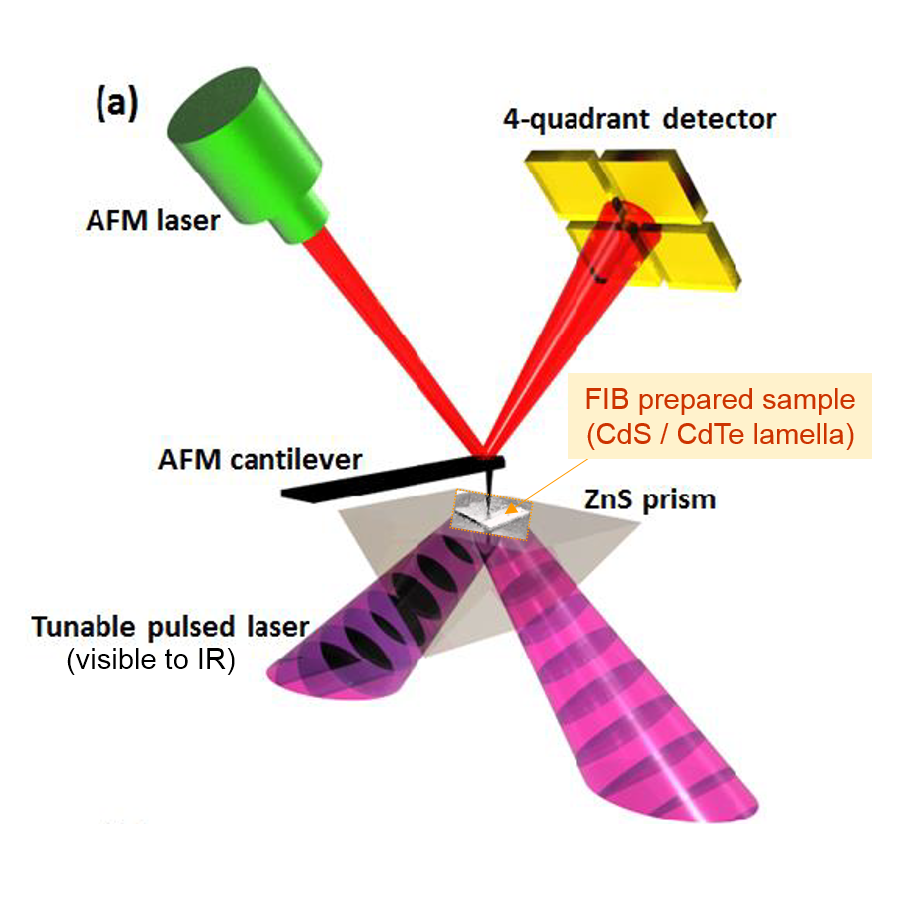
ABSTRACT. Polycrystalline thin film technology has shown great promise for low cost, high efficiency photovoltaics. To further increase the power efficiency, a firm understanding of microstructural properties of the devices is required. In this work, we investigate the inhomogeneous electrical and optical properties using local excitation techniques that generate excess carriers by a near-field light illumination or by a focused electron beam irradiation. The spatially resolved photocurrent images of n-CdS / p-CdTe devices obtained by both techniques show high carrier collection efficiencies at grain boundaries. A novel and complementary technique, photothermal induced resonance (PTIR), is also used to obtain absorption spectra and maps in the near-field over a broad range of wavelengths. In PTIR a wavelength tunable pulsed laser is used in combination with an atomic force microscope tip to detect the local thermal expansion induced by light absorption. Sub-micrometer thick lamella samples of CdTe solar cells are measured, and the variation of local band-gap is analyzed. We discuss the resolution and the sensitivity of the techniques in the range of photon energies close to the band gap.
LINK

2015 Nanotechnology

Paul_NanotechnologyElectron beam induced current in the high injection regime”, P. M. Haney, H. P. Yoon, P. Koirala, R. W. Collins, and N. B. Zhitenev, Nanotechnology 26, 295401, 2015.

1. Center for Nanoscale Science and Technology, National Institute of Standards and Technology, Gaithersburg, MD 20899, USA.
2. Maryland NanoCenter, University of Maryland, College Park, MD 20742.
3. Dept. of Physics and Astronomy, University of Toledo, Toledo, OH, 43606.

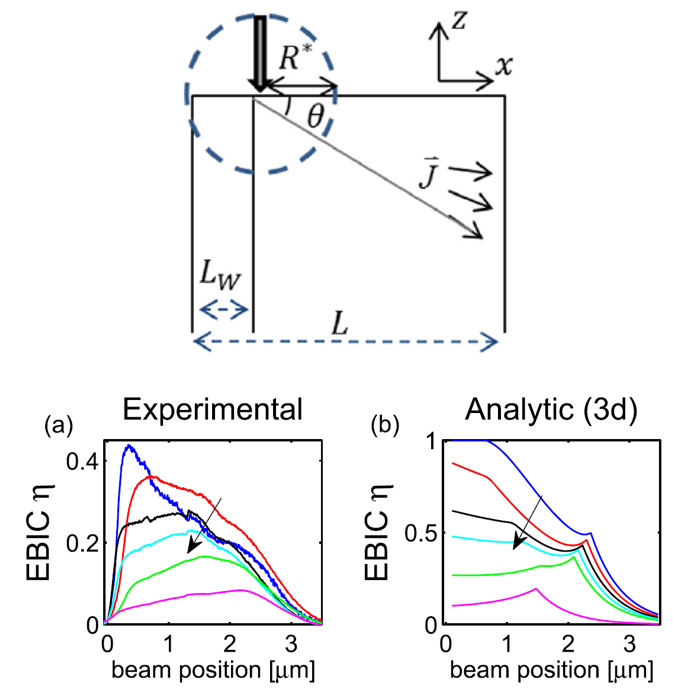
ABSTRACT. Electron beam induced current (EBIC) is a powerful technique which measures the charge collection efficiency of photovoltaics with sub-micron spatial resolution. The exciting electron beam results in a high generation rate density of electron–hole pairs, which may drive the system into nonlinear regimes. An analytic model is presented which describes the EBIC response when the total electron–hole pair generation rate exceeds the rate at which carriers are extracted by the photovoltaic cell, and charge accumulation and screening occur. The model provides a simple estimate of the onset of the high injection regime in terms of the material resistivity and thickness, and provides a straightforward way to predict the EBIC lineshape in the high injection regime. The model is verified by comparing its predictions to numerical simulations in one- and two-dimensions. Features of the experimental data, such as the magnitude and position of maximum collection efficiency versus electron beam current, are consistent with the  three dimensional model.

LINK

2015 IEEE Photovoltaic Specialists Conference

pvsc_2015_posterLocal Photocarrier Dynamics in CdTe Solar Cells Under Optical and Electron Beam Excitations”, H. P. Yoon, P. M. Haney, Y. Yoon, S. An, J. I. Basham, and N. B. Zhitenev, 42th IEEE Photovoltaic Specialists Conference, p. 1, 2015. (DOI: 10.1109/PVSC.2015.7356020)

1. Center for Nanoscale Science and Technology, National Institute of Standards and Technology, Gaithersburg, Maryland, 20899, USA.
2. Maryland Nanocenter, University of Maryland, College Park, Maryland, 20742, USA

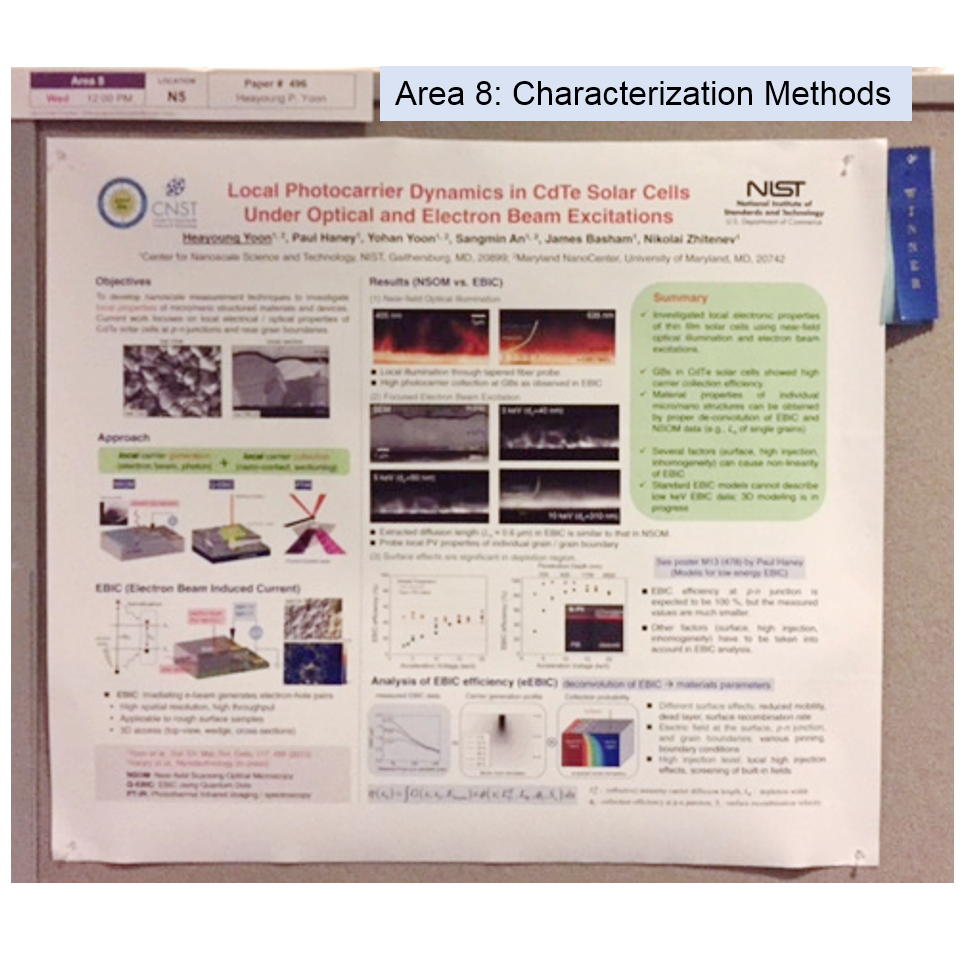
ABSTRACT. We compare local carrier dynamics in n-CdS / p-CdTe solar cells, where the electron-hole pairs are generated by either near-field optical illumination or highly focused electron beam excitation. An ion beam milling process was used to prepare a smooth surface of cross-sectional devices. The spatially resolved photocurrent images confirm high carrier collection efficiency at grain boundaries. An analytical model was used to extract material parameters at the level of single grains. We find that the minority carrier diffusion lengths extracted from both local measurement techniques are in excellent agreement, but are smaller than the values determined from macro-scale measurements.

LINK